July 2022 - May 2023
Program development and partnership building
An action research program on new approaches to local economic development (2023-2025)
Rebonds (Bounce back) is a participatory action research program aiming to explore and test new approaches to local economic development, serving the goals of social justice and combating climate change. It is being conducted with economic developers from a dozen local governments across France.
The idea for Rebonds was born in 2019 in the context of the yellow vest movement in France, followed by the Covid-19 pandemic and repeated calls to build a “new social contract” across Europe.
It was during this period that representatives of a group of local authorities and NGOs traveled across Europe, on the initiative of the 27th Region, to meet with territories promoting alternative development models inspired by the commons, as part of the Enacting the Commons program. They visited cities such as Manchester, Amsterdam, Bologna, Ghent, Barcelona or Athens.
The first lesson that participants drew from this exploration deals with the goals of economic development: the combined effects of ecological, social, and geopolitical crises are leading several regions to seek new economic development paradigms and to rethink their approaches in order to achieve goals such as ecological transition, social justice, and relocation. The aim is obviously to “bounce back” by curbing the consequences of this intertwining of crises, but also to reorient traditional models towards fundamental needs.
The second lesson deals with economic development practices and tools: these new models radically challenge the governance, professions, and traditional rituals of economic development. For example, in terms of contracting or business support. They also renew the scope and variety of instruments used by public actors, from the most traditional, such as public procurement policies, to the most emerging, such as new forms of ecological accounting.
All these approaches are still in their first steps and are little known, specially in France. However, they could be a source of inspiration for economic development actors, who express difficulty in moving away from the CAME (Competitiveness, Attractiveness, Metropolization, Excellence) model and in initiating transformations that truly form a system, producing public policies in line with the challenges of the Anthropocene, reconciling the economy and transition, and reconciling the economy and transition. Metropolization, Excellence) model, which is in crisis, and to initiate truly systemic transformations, produce public policies in line with the challenges of the Anthropocene, reconcile the economy and transition, and develop the profession of economic developer in this direction.
It is for all these reasons that we launched Rebonds, a multidisciplinary action research program aimed at:
1) A collaborative survey - 6 months
In France and around the world, a survey of concrete initiatives, movements, and theories that foreshadow a new generation of economic development policies.
2) Local experimentations (1.5 years)
Between six and twelve tests carried out to “exemplify” the future of economic development policies and make them desirable. Examples of tests to be carried out: an alternative roadmap for an economic development agency, rethinking its place, role, and mission in more “localized” and circular ecosystems; the collective production of new evaluation methods and indicators to devise a systemic local economic strategy shared among local stakeholders; a new job description for the local economic development manager.
3) Capiotalisation and narratives (continuous throughout the program)
To better describe, inspire, popularize, and illustrate the new economic development policies we wish to bring about.
Program development and partnership building
Program launch
Phase 1 - Exploration
Phase 2 - Experimentations
Phase 3 - Capitalisation, debates
The 27th Region, as an independent association, coordinatates the program and its evaluation.
On the research side: Magali Talandier and Gabriel Renault - Grenoble Alpes University, Pacte laboratory.
The community of municipalities of Puisaye Forterre, Bassin de Pompey and Val de Garonne, the PETR of Figeac/Vallée de Dordogne and the metropolitan areas of Lille, Rennes, Grenoble, Nantes, Bordeaux, Orléans and Montpellier.
France Urbaine and Intercommunalités de France, as networks of elected officials.
Rebonds also benefits from the support of ADEME, Fondation de France, and Cerema.
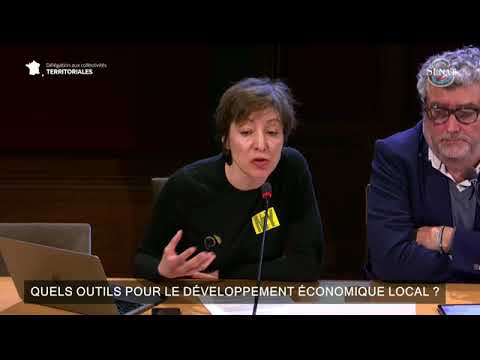
Présentation réalisés dans le cadre de la commission "Quels outils pour le développement économique local ?" par la délégation aux collectivités territoriales.
A way to follow up the program, step by step

Information
Credits
Transcription