When public administrations support public agents to switch path

Addressing the climate and ecological crisis requires a rapid shift in the professional practices of all local government employees. A survey conducted by the CNFPT in March 2023 reveals that for local government leaders, this is the top priority-ahead of raising awareness or promoting eco-friendly behaviors-even though training, as a tool for changing the professional practices specific to different job roles, appears to have been underutilized thus far.

So how can we develop the skills and professional practices needed to address the challenges of the ecological transition? How can we foster understanding and ownership among all staff members (not just managers) of the constraints and challenges, create a shared culture around the urgency of transforming public action, and translate that into concrete action at all levels? How can we support these changes in practices while recognizing and safeguarding the work and capabilities of staff members? What roles and approaches should frontline managers adopt?

During a webinar on March 25, testimonials from Laurent Fussien, Director General of Services for the City of Malaunay, Paul Aubier and Aïdan Young-respectively, project manager for the transformation of the food service model and user-centered approach, and project manager for ecological transition at the Department of Seine-Saint-Denis- Anaïs Bodino, Project Manager for Innovation and Participation, and Béatrice Labourier, Director of Employment and Skills, for the City of Clermont-Ferrand, provided initial insights through their unique experiences-experiences that complement and resonate with one another.

Malaunay: Using the administration project as a catalyst for transition and the promotion of professional Practices

In Malaunay, the transition process is by no means a recent development. Launched some twenty years ago and consolidated over the years, bolstered by the town's involvement in the Fabrique des Transitions, the ambition today is to achieve a systemic transformation, which cannot succeed without the full involvement of the local authority and its 110 staff members.

"We are constantly asking ourselves questions about roles, expectations and needs": the electrician in charge of the upkeep and maintenance of solar panels; the head of the CCAS who supports the most vulnerable households during home visits; the communications officer who has become a storytelling coordinator; the Chief Executive Officer who has become the driving force behind staff capacity-building... These are all examples that illustrate the shift away from staff members' traditional roles and approaches, as well as the recognition of these necessary professional transitions.

To this end, in 2019 the senior management team committed the local authority to a shared services project: a managerial, technical and administrative roadmap extending to 2030, comprising around forty initiatives and designed as a 'compass for rethinking the way we work'. Its development was based on individual meetings with every local authority staff member to ensure the most precise possible job-specific approach and to identify each person's skills. This long-term exercise aims to develop a framework capable of addressing both day-to-day issues and the many challenges of the future, and to implement the necessary changes. In this regard, Laurent refers to the concept of GPEC (forward-looking management of jobs and skills) with a systemic focus, and the delicate challenge of meeting the needs for change and skills development required for systemic transformation, despite the uncertainties we face today.

This transformation process is also proving to be a key factor in the organisation's appeal as an employer; some staff members have chosen to work in Malaunay because they have not yet found opportunities for this kind of commitment and professional alignment in other local authorities. It also serves to recognise the value of the staff's work, with their practices and initiatives being particularly highlighted during DDT Tours.

To find out more about Malaunay's transition process, click here.


In Seine-Saint-Denis: a ‘Space for Sharing and Skills’ to bring together the 1,500 secondary school staff and embark on a collective transformation.

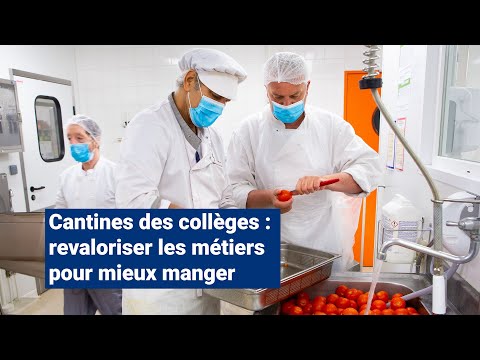
In April 2022, against a backdrop of staffing challenges in the catering sector (a crisis in recruitment, practices disrupted by Covid, the Egalim Act, etc.), that the Education Department launched the Espace des Partages et des Savoir-Faire (EPSF), aimed at all staff working in catering, reception, cleaning and maintenance across the 130 secondary schools and 7 central kitchens in the Seine-Saint-Denis and Essonne regions (1,500 staff). This in-house training programme aims, above all, to bring together a community of staff (across different sites), develop their professional practices and inspire new ones that incorporate societal challenges and the ecological transition. To this end, the Department has focused on peer-to-peer sharing and exchange, as well as the transmission and promotion of these staff members' expertise, in line with the principles of popular education.

The EPSF runs alongside the existing training provision and offers a programme of half-day workshops, on a voluntary basis, covering a variety of topics ranging from developing vegetarian recipes to the use of digital tools, as well as issues such as career development and the operation of eco-friendly and ergonomic maintenance machinery. Since its launch, around forty workshops have been held, bringing together a total of 350 participants.

Group days (which are compulsory - in line with the working time reform) are also organised three times a year, combining plenary sessions, social time and forums... helping to foster cohesion and a sense of belonging amongst sites and staff. These sessions also provide an opportunity to share experiences, with an open mic for those who have launched initiatives on their own initiative (for example, the 'petite faim grande faim' scheme to reduce food waste) and would like to share them with their colleagues. The EPSF also has two communication channels: the 'colleagues from secondary schools' WhatsApp group, which brings together 800 staff members and is used, in particular, to publicise the range of workshops on offer, and a YouTube channel, which serves as a platform for showcasing workshops and events after the event.To draw even more on staff members' knowledge and skills, the Department is now giving them the opportunity to become workshop leaders themselves. A recruitment campaign has thus enabled the identification and support of around fifteen colleagues within the organisation to become trainers, and a second cohort will follow during the next academic year ...

For the Ecological Transition Department, this project serves as a good internal showcase and fits well within the regional food initiative for the Seine-Saint-Denis area and its three pillars: generating knowledge, building on existing resources, and forging links. Discussions are also underway on rolling out this peer-to-peer sharing model across the region, particularly to reach other professional sectors, whilst remaining closely linked to the ecological transition.

In Clermont-Ferrand: trialling a ‘Form’action’ programme on transitions to engage staff in the public administration for the future.

By making the provision of tools and training for staff on environmental, social and democratic issues a key pillar of its administrative programme, the City of Clermont-Ferrand sought to equip itself to rethink traditional approaches to fostering a culture of ecological transition, with a view to mobilising the entire administration.

A project team comprising the Innovation and Participation Department, the Employment and Skills Department, the Internal Communications team and the CNFPT was set up to develop a tailor-made training programme, organised into four modules (ecological transition, social issues, democratic issues and internal cooperation), combining different formats and examples directly and practically linked to staff practices and the local context. The sessions led by CNFPT trainers will therefore be complemented by the sharing of real-life experiences by civil servants from Clermont-Ferrand (for example, the 'social issues' section will draw on accounts from staff at the Urban Social Development department or the CCAS), as well as contributions from less 'obvious' stakeholders (such as a theatre company or researchers). Advocating a trial-and-error approach and co-creation, the team conducted an initial trial of the ecological transition module with around thirty volunteer staff members, with a view to improving and enriching both its content and format, before organising a first full session with the directors, the 80 staff members randomly selected to take part in the administrative agreement, and the training facilitators.

With the ambitious aim of training 2,200 staff members over the course of two years in four half-day sessions, so that all staff members have a basic understanding of the issues at stake, the Form'action programme is expected to bring together no fewer than 200 people at a time ... Finding a format that is attractive, participatory, practical and engaging for participants therefore remains a real challenge!Although involved in the project from the outset, this approach also challenges and calls into question the role of the Employment and Skills Department, and more broadly that of HR, the cornerstone of change (and a glass ceiling that is difficult to break through, as one webinar participant noted): how can we support transitions whilst examining the nature of the roles? What new HR practices are needed - from recruitment to training provision and workforce monitoring (for example, in very practical terms, how should the issue of transitions be addressed during a recruitment interview for a school teaching assistant)? Béatrice Labourier sums up her current challenge in a few words: "Clearly defining how far we want to go, to what extent the initiative is politically supported, and what resources we are allocating to achieve it ... That is the task facing management over the coming months.

"Recognition, the right to participation, inclusivity...: some key challenges in developing this type of initiativeHere and there, local authorities are therefore attempting to tackle head-on the issue of the diversification of roles and professional practices, building as far as possible on existing practices. Beyond the most suitable format, a number of factors determine its success and its truly transformative nature:

The recognition of these new schemes, sometimes rolled out alongside traditional, certification-based training, and in particular the possible forms of accreditation. In Seine-Saint-Denis, certificates have been awarded to participants in certain workshops to validate the skills acquired; in Clermont-Ferrand, a CNFPT certificate is issued for the two-day 'form'action' programme; in Malaunay, staff commitment is recognised by the Mayor and the Chief Executive, particularly when hosting delegations.

A right to participation (it should be noted that the City of Lyon has worked on this right to participation for staff), enshrining and facilitating the allocation of time for staff so that they can participate in these schemes without pressure (through measures such as cover arrangements, support from management, terms of reference setting out the time required for involvement, on-site arrangements to accommodate staff members' constraints, etc.). In Malaunay, Laurent Fussien pays particular attention to the risk of burnout, and encourages a focus on managerial restraint and prioritising high-impact actions.

The need to take into account people's varying levels of engagement with these issues and their willingness to change, so as not to create new divisions within teams. One approach put forward by Béatrice Labourier is to raise awareness of the subject amongst organisational advisers, so that they can provide enhanced support where necessary. Laurent Fussien also explains how to turn these initiatives into a strategic asset: the local authority's exemplary approach can foster a sense of pride among staff and serve as a tool to win people over, including those who might not otherwise have been reached. Similarly, developing practices that also improve working conditions (for example, differentiated management of green spaces) fosters staff commitment.

The importance of senior management setting an example (the General Management Service in Clermont-Ferrand, for example, is following the INET transitions programme to help drive the initiative forward).